 Skip to content
Nonprofit Lost Tax-Exempt Status? What Happens and How to Get Reinstated
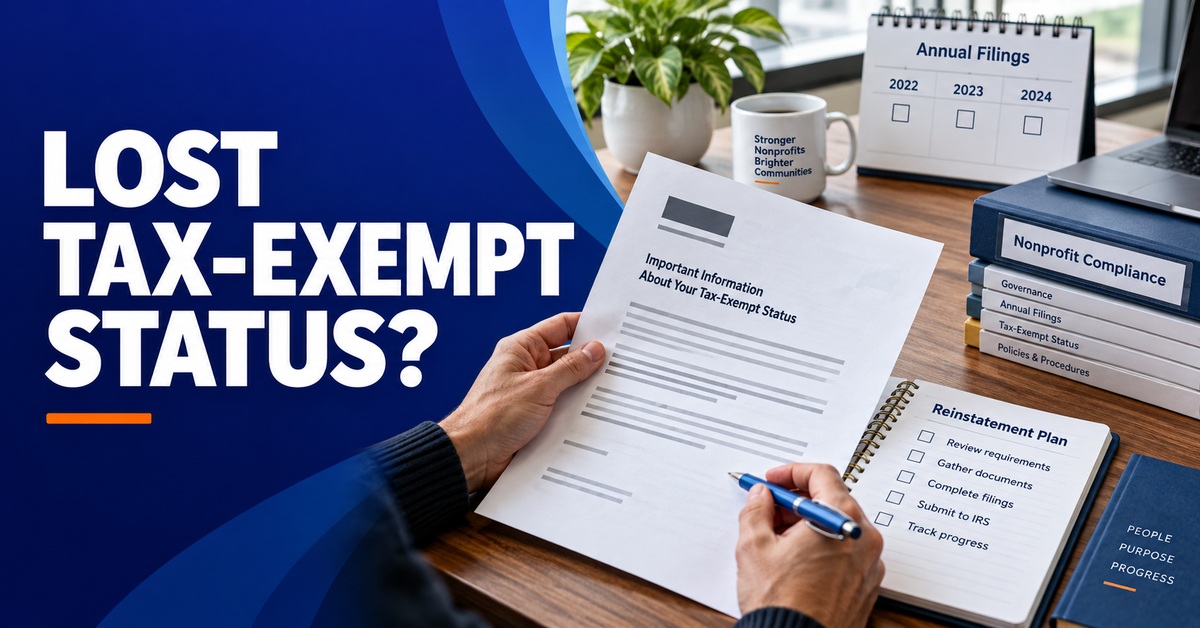
Losing federal tax-exempt status can interrupt fundraising, create tax exposure, and raise difficult questions from donors, grantmakers, banks, and state agencies. The problem is serious, but many organizations can recover if they confirm the facts quickly and choose the correct reinstatement process.
For most nonprofits, automatic revocation happens after three consecutive years of missed Form 990-series filings. Reinstatement requires more than submitting the missing returns. The organization generally must file a new exemption application, pay the applicable IRS user fee, and determine whether it qualifies to request retroactive reinstatement.
How automatic revocation happens
A tax-exempt organization that fails to file its required annual return or notice for three consecutive tax years automatically loses its federal tax-exempt status. The filing may be Form 990, Form 990-EZ, Form 990-PF, or Form 990-N, depending on the organization. Revocation takes effect on the due date of the third missed filing.
This is automatic by law. The IRS explains that a proper automatic revocation cannot be undone through an appeal. An organization must apply for reinstatement even if it was not originally required to submit an exemption application. Review the IRS automatic revocation guidance for the current federal rules.
Federal tax exemption is different from nonprofit corporation status under state law. An organization may still legally exist as a nonprofit corporation while no longer being recognized by the IRS as exempt from federal income tax. State tax exemptions, charitable registration, contracts, and other state requirements may also be affected.
What losing tax-exempt status can mean
Automatic revocation can affect several parts of an organization at once:
- Federal income tax: The organization is no longer exempt from federal income tax and may be required to file Form 1120 if it is a corporation or Form 1041 if it is a trust, along with any applicable tax.
- Charitable contributions: A revoked 501(c)(3) organization is not eligible to receive tax-deductible contributions while revoked. The IRS states that donors generally may deduct contributions made before the organization appears on the Automatic Revocation List. Retroactive reinstatement can change the result for the reinstated period.
- Public records: The organization is removed from the IRS list of organizations eligible to receive tax-deductible contributions. The automatic revocation remains visible in IRS records even after reinstatement, although the reinstatement date is also shown.
- Grants and contracts: Funders, government agencies, banks, and vendors may require current proof of exemption. Revocation can delay funding or trigger reporting duties under existing agreements.
- State compliance: State income, sales, franchise, or property-tax exemptions may be affected. Charitable registration requirements may also continue even when federal exemption has been revoked.
First confirm the status and the timeline
Start with the IRS Tax Exempt Organization Search. Search the organization by its legal name and employer identification number. Review the Auto-Revocation List, determination-letter records, and available Form 990 filings.
Gather the IRS revocation notice, often Letter CP-120A, and identify three dates: the effective date of revocation, the date of the IRS letter, and the date the organization was posted to the Auto-Revocation List. The 15-month reinstatement window is measured from the later of the letter date or the posting date.
Also confirm which returns were required for each year. Gross receipts, assets, private-foundation status, and other facts can change the correct filing form. Do not assume that a small organization was eligible for Form 990-N in every missed year.
If the organization has proof that it filed a required return or extension on time, the listing may be wrong. Follow the IRS correction process and provide documentation before assuming a new exemption application is necessary.
The four federal reinstatement paths
The IRS describes four reinstatement procedures. The right path depends on the organization’s filing requirements, timing, and history. See the IRS reinstatement procedures before selecting a filing approach.
1 Streamlined retroactive reinstatement
This process may be available when the organization was eligible to file Form 990-EZ or Form 990-N for each of the three years that caused the revocation, has not been automatically revoked before, and submits the reinstatement application within 15 months after the later of the revocation-letter date or the date it appeared on the IRS list.
If the request is approved, reinstatement is effective back to the revocation date. An organization that was eligible to file Form 990-N for a missed year generally is not required to submit a prior-year Form 990-N. If Form 990-EZ was required, the delinquent returns must be handled under the IRS procedure.
2 Retroactive reinstatement within 15 months
An organization that cannot use the streamlined process may still request retroactive reinstatement within the 15-month period. This commonly applies when Form 990 or Form 990-PF was required for one of the three years or when the organization was previously revoked.
The application must include a reasonable-cause statement for at least one of the three missed years, confirmation that required delinquent returns have been filed, and the other information required by the applicable IRS procedure.
3 Retroactive reinstatement after 15 months
Retroactive reinstatement may still be requested after the 15-month period, but the reasonable-cause standard is harder to meet. The organization generally must establish reasonable cause for its failure to file in all three consecutive years and complete the delinquent-filing requirements.
4 Reinstatement effective from the application date
An organization may apply for reinstatement without requesting that the exemption be restored to the original revocation date. If approved, the effective date is generally the application submission date. This route can be simpler, but it leaves a nonexempt gap that may create income-tax, donor, grant, and state-compliance issues.
What makes a reasonable-cause statement credible
A reasonable-cause statement should explain why the filing failures occurred and show that the organization exercised ordinary business care and prudence. A general statement that a volunteer forgot, the board did not know, or the organization had no activity is usually not enough by itself.
A well-supported statement normally addresses:
- The specific facts and dates behind each missed filing covered by the request
- Who was responsible for the filings and what oversight existed
- How and when the organization discovered the problem
- What the organization did after discovery
- The procedures now in place to prevent another failure
- Documents that support the explanation
The IRS evaluates the full facts and circumstances. The explanation should be accurate, consistent with the organization’s records, and approved by the appropriate leaders.
What to file while reinstatement is pending
Filing duties do not necessarily stop while the IRS reviews the application. An organization that is not eligible for Form 990-N generally must file Form 990, Form 990-EZ, or Form 990-PF for each tax year that ends while the application is pending and check the application-pending box. The IRS provides separate filing guidance for organizations awaiting reinstatement.
An organization eligible to file Form 990-N because its annual gross receipts are normally $50,000 or less generally does not submit Form 990-N until the reinstatement application is approved.
Seven steps to take now
- Verify the IRS record. Confirm the legal name, EIN, revocation date, posting date, and whether reinstatement has already been recorded.
- Protect donor and funder communications. Do not continue issuing broad assurances that contributions are deductible without reviewing the organization’s current status and proposed effective date.
- Reconstruct the filing history. Determine the return required for every missed year and every later year.
- Choose the reinstatement route. Evaluate the 15-month deadline, prior revocations, Form 990-series eligibility, and whether retroactive treatment is needed.
- Prepare the exemption application and supporting statements. A 501(c)(3) organization generally uses Form 1023 or, if eligible, Form 1023-EZ. Other types of exempt organizations use the application applicable to their Code section.
- Address federal and state gaps. Evaluate income-tax returns, delinquent information returns, charitable registration, and state exemptions.
- Install a filing calendar and backup controls. Assign an owner, a reviewer, and board-level monitoring for each annual filing.
Common reinstatement mistakes
- Assuming that submitting the missing Form 990 filings will automatically restore exemption
- Using Form 1023-EZ without completing the current eligibility worksheet
- Missing the 15-month deadline while gathering records
- Submitting a short reasonable-cause statement with no dates, controls, or supporting facts
- Ignoring returns due while the reinstatement application is pending
- Telling donors that every contribution remains deductible before the requested effective date is approved
- Focusing only on the IRS and overlooking state agencies, grant agreements, and contracts
The bottom line
Automatic revocation does not always end a nonprofit’s work, but delay can narrow the available options and increase the cleanup required. Confirm the dates, determine the correct filing history, and select a reinstatement path before submitting forms or communicating with donors.
The NonProfit CPA helps 501(c)(3) organizations evaluate missed filings, prepare Form 990-series returns, and organize the financial information needed for reinstatement. Learn more about our Form 990 preparation services or contact us to discuss your organization’s situation.
This article provides general educational information and is not legal advice. Reinstatement outcomes depend on the organization’s facts, filing history, governing documents, and current IRS procedures. Consult qualified tax and legal advisers about your organization’s specific circumstances.

Trent Foster, CPA, is the founder of The NonProfit CPA and has more than 25 years of experience working with nonprofit organizations. His experience includes leading nonprofit accounting services at a national accounting firm and serving organizations ranging from startups to nonprofits with more than $2 billion in revenue. Today, Trent works exclusively with nonprofits, providing specialized accounting, bookkeeping, financial reporting, CFO support, and Form 990 preparation.
